
Archives
-
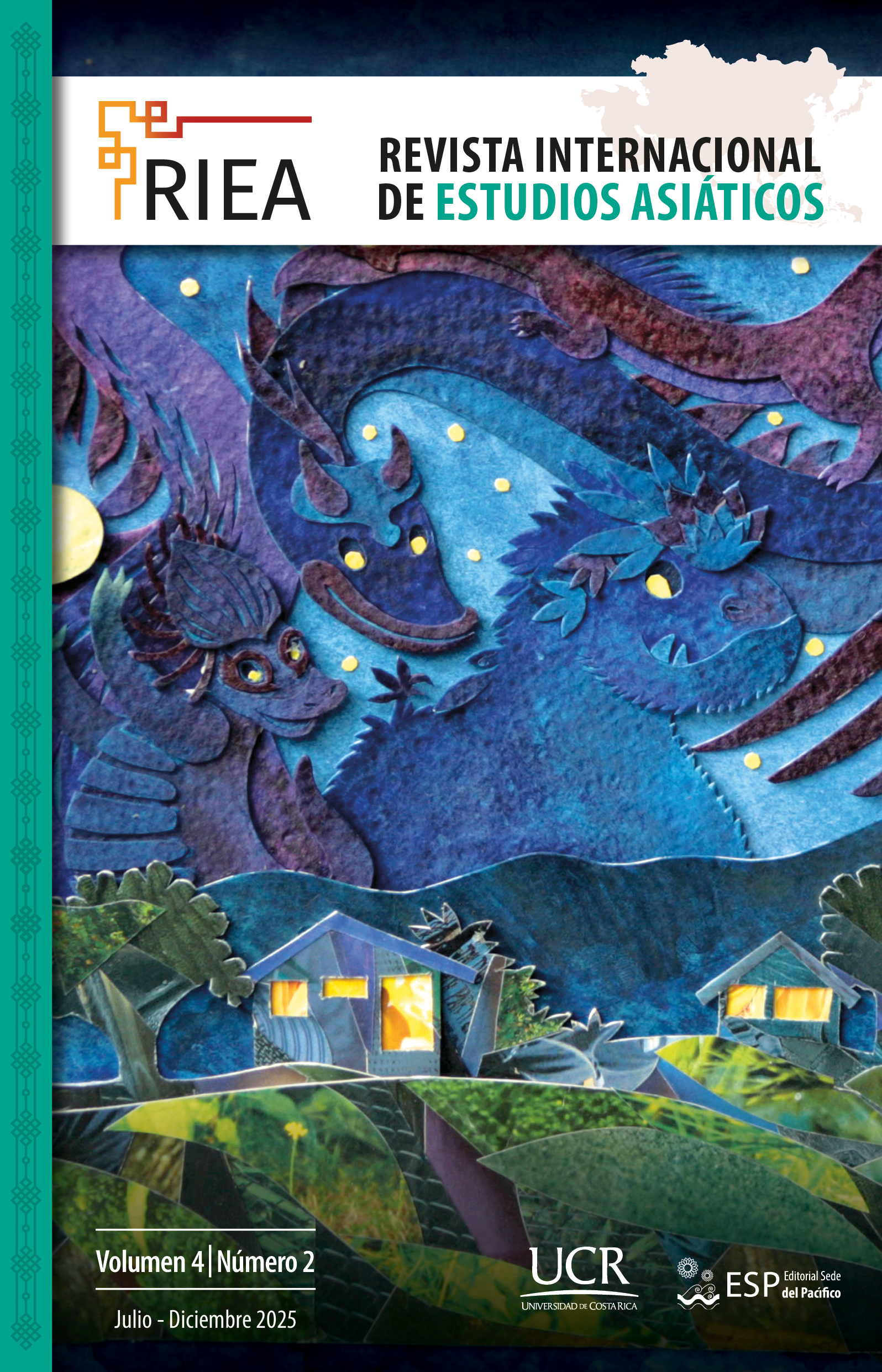
Vol. 4, no. 2, July-December 2025 | Asia in the World: Different Phenomena in Global Scales
Vol. 4 No. 2 (2025)The next issue of the International Journal of Asian Studies (RIEA) offers, from various analytical perspectives and historical moments, the presence of Asian universes operating in very dissimilar realities but linked by actors and social phenomena that generate new realities.
These pages contain interpretive insights that reflect on the academic fields specializing in studies of Asian societies and their links to other social and cultural realities. On this occasion, the pages of this new issue of RIEA offer a substantial ten articles (from the peer-reviewed section), as well as five book reviews that confirm the current boom in academic production in the Spanish language, both in texts written in this language and in translations into it.
The issue begins with an article that analyzes how Mexican foreign policy has been permeated by the humanitarian crisis in Gaza, especially since October 7, 2023, and how it has addressed its position on the genocide being perpetrated there. The next article delves into the Portuguese conquest of the city of Malacca, which began at the dawn of the 16th century, to explain how the port landscape was transformed by colonial action, thus also changing the perception of the city in India, which was beginning to see a European presence. Subsequently, the issue offers a work that analyses the therapeutic dimension of Indian philosophy from an analytical approach based on authors such as Pierre Hadot, Michel Foucault, and Martha Nussbaum. This allows, as the text points out, to gauge the position of the therapeutic conditions of the philosophy that emerged from India in order to understand a search for a return to the self that is explained in its pages.
Following these articles, the rest of the issue consists of three articles focused on to Korea and four connected to historical experiences of Chinese communities in various historical, geographical, and cultural settings. With regard to the articles related to Korea, two of them are related to the construction of Korean identity from outside its socio-political and cultural environment, and another to the insertion of South Korean companies into the world of technological advances. Of those related to the first aspect, one analyzes the Korean migrant population to China, which took place voluntarily in the 19th century, these immigrated people are known as Chaoxianzu. The text draws on the work of Jin Xuetie (Kim Hak-chul), a Korean-Chinese novelist from the post-Maoist era, who explores the cultural changes that this population has undergone. The other article, meanwhile, delves into the way in which non-Korean cinema has represented and reconstructed the identity of Koreans in other cultural spheres. Nearly 200,000 Korean children have been adopted by people from Western countries, and the text cites 27 film productions that have addressed this phenomenon and the cultural challenges it has posed for these children and their cultural identities. The latest one on Korea, particularly South Korea, aims to explain the strategies and innovations undertaken by the country’s capital to achieve the highest standards in investment and development (I & D). In this way, based on the creation of patents in this country by companies, universities, and research institutes between 2000 and 2021, it explores how South Korea has generated all the innovation development that characterizes it today.
The other four articles in the refereed section are devoted to phenomena related to Chinese communities in different historical contexts. One of them analyzes the text written by the Dominican Domingo Fernández de Navarrete in 1676, in which he describes Chinese culture at the time. The book was a bedside companion for Catholic missions in China, and the article delves into its contents. The next one analyzes a complex phenomenon related to Chinese workers in Cuba in the second half of the 19th century (the so-called coolies) and their condition as slaves until their transition to free workers. The following work analyzes the dynamics of informal Chinese trade between 2020 and 2024 in Mexico City and its ecological consequences in the Mexican capital, pointing out the processes of environmental deregulation that have allowed it to flourish. Finally, the section of peer-reviewed articles concludes with a work that compiles and analyzes the works of artists of Chinese origin in Costa Rica, based on the intrinsic relationship between society, history, and culture in their works. The article emphasizes the lack of research on these artists in the country and, therefore, the need to open up more academic spaces for analysis of their creations. Finally, the issue offers reviews of five works that address a series of topics relevant to the realities of Asian societies and that will become essential references in each of the fields from which they were formulated. These works are: El libro del campamento by Zafer Al-Katheeb, on Palestinian refugee camps in Lebanon; Las relaciones de Costa Rica con el Medio Oriente y el Norte de África: pasado y presente de una relación que se transforma, by Carlos Humberto Cascante Segura and Sergio Iván Moya Mena, a meticulous and well-documented study of the history of Costa Rica’s diplomatic ties in those regions of the world; Subjetividades orientalistas, tres volúmenes: Tomo I. Imaginarios, Tomo II. Cultura política, y Tomo III. Religiosidades, edited by Ricardo Martínez Esquiveland Francisco Rodríguez Cascante, which contributes to the discussion on Orientalism in and from Latin America; China’s Strategic Opportunity: Change and Revisionism in Chinese Foreign Policy, by Yong Deng, a book that dissects the concept of strategic opportunity in 21st-centuryChina led by Xi Jinping; and finally Financial Euphoria, Consumer Culture, and Literature of 1980s Japan, by Ikuho Amano, which explores the phenomenon of the Japanese economic bubble of the 1980sand the products that emerged from it in literature and the mass media.
Esteban Sánchez Solano
Universidad de Costa Rica, San José, Costa Rica
-

Studies of Chinese Philosophy in the Contemporary World
Vol. 5 No. 1 (2026)The academia of Asian studies in Spanish: The need for ongoing discussion
The International Journal of Asian Studies (RIEA) continues its work of exploring and promoting a rigorous and specialized academic space concerning Asian cultures. For decades, the University of Costa Rica, through several academic departments and Faculties, has organized conferences, symposiums, and congresses on these topics, as well as inviting foreign scholars who have enriched the university's academic work in this regard. For this reason, since its inception, RIEA has sought to be a platform par excellence for contributing to these academic endeavors.
Precisely, in order to continue along this path, the following issue offers a dossier that brings together some of the papers presented at the II Congreso Internacional de la Red Iberoamericana de Filosofía China (RIFCH), entitled “La filosofía china y sus aportaciones a las Humanidades”, which was held on August 27th and 28th, 2025, and sponsored by the Confucius Institute at the University of Costa Rica. This Congress gathered, in a hybrid format, various specialists from countries such as Peru, Costa Rica, Italy, the United States, and Spain, among others. The dossier has a short introduction that briefly details the content of the articles it contains.
Similarly, the peer-review section includes an article on distance learning of Chinese during the pandemic, as well as the book review section, which is always well stocked with recently published books on Asian societies, in this case on Chinese cultures, as a complement to the dossier on Chinese philosophy mentioned above.
We would also like to take this opportunity to congratulate Carlos Calderón Herrera, from the University of Costa Rica, who won the Best Theoretical-Aesthetic Research Award from the Asociación Internacional de Críticos de Arte (AICA) for his article “Voces de una identidad olvidada. Reflexiones en torno al trabajo visual de artistas costarricenses de origen chino”, published in RIEA in Vol. 4(2): 248-288 (July–December 2025). The event at which Calderón Herrera received the award took place on February 18th, 2026, at the National Library in San José, Costa Rica.
Esteban Sánchez Solano
Universidad de Costa Rica,
San José, Costa Rica
-

A Body of Work, a Field, an Agenda: Roberto Marín Guzmán and the Study of Islam and the Middle East from Costa Rica
Vol. 5 No. 2 (2026)Presentation
A Work, a Field, an Agenda: Roberto Marín Guzmán and Studies on Islam and the Middle East from Costa Rica
Dr. Roberto Marín Guzmán (1955-2024) became one of the leading references in the Social Sciences in Costa Rica. He was the author who introduced studies on Islam and the Arab world to the academic world, after having achieved professional training in these fields in Mexico and the United States. He also developed his academic work at the University of Costa Rica, as well as at other universities and research centers worldwide in which he participated as a visiting professor, with research stays and other forms of academic collaboration. In addition, it should be noted that he twice won the Aquileo J. Echeverría National History Prize, in 1986 and 2026 with the works Islam: ideology and history and Society, politics and popular protest in Muslim Spain, respectively. After his death, the International Journal of Asian Studies of the University of Costa Rica offers this dossier that delves into the analysis of the vast work of Dr. Marín Guzmán based on the contribution of five people who collaborated closely with him and delve into the entire thematic, theoretical, methodological and heuristic range of his academic production.
The issue begins with an unpublished text by Roberto Marín Guzmán on Islamophobia, a topic that he explored in the last part of his academic life from a Central American perspective. In this way, Dr. Marín Guzmán offers the global condition that Islamophobia has already presented for many decades and explores it with his characteristic assiduity and thoroughness. Subsequently, the issue opens the dossier and proposes five readings of the work of this great Costa Rican academic. The first text proposes the way in which Dr. Marín Guzmán established religious studies on Islam in Costa Rica as a disciplinary field, based on his intellectual and academic itinerary between 1978 and 1990. Then, the following article proposes a detailed analysis of the construction of studies on the Middle East developed by Roberto Marín from his studies on the conflicts in the region, with special emphasis on the Palestinian-Israeli one, very present in academic production from early on.
Likewise, the dossier then offers a text that makes a meticulous theoretical scrutiny of the concept of the political in Dr. Marín's work and the way in which the construction of this theoretical universe is imbricated in the very historicity of Islam, widely studied by the author. Subsequently, an article is offered which takes as a starting point the work of Marín Guzmán in relation to his analyses of protest movements and revolts in the Islamic world and undertakes an in-depth investigation into the Panthay revolt in China (1856-1873). This text allows us to see the theoretical richness of Roberto Marín's work to explore the various edges that the Islamic world presents in other geographical and cultural latitudes to which Islam arrived. Finally, the dossier ends with the detailed study of the Palestinian-Israeli conflict in the work of Marín Guzmán in the long duration in which the colonial conditions of the historical phenomenon are explored and the approach of subaltern studies from which the analysis of the work of Roberto Marín can also be nourished.
In addition to the dossier, the issue offers in the refereed section three articles that analyze historical phenomena related to the Islamic and Arab world that complement the elements discussed by the authors regarding the work of Roberto Marín Guzmán. The first of them is a text that delves into the way in which Ibadi Islam is intertwined in the foreign policy of Oman, a country in the Arabian Peninsula that has had a very particular agenda in the region from the 1970s to the present. The following article offers a complex look, from the psychology of religion, on the consequences of the destruction to which Palestine has been subjected, but with the aim of finding within the morass that this people is experiencing, forms of hope about their history and their future. Finally, this section ends with a text that reviews, particularly from the national censuses, the migratory processes of the Arab populations of the Levant to Costa Rica from the second half of the twentieth century to the year 2022.
Finally, the issue offers the review of three books that are part of the latest published works, co-authored, by Roberto Marín Guzmán, which demonstrate his prolific production. Likewise, this allows us to verify the author's incessant search to continue with academic studies on Islam and the Arab world, in the first instance, from a historical perspective, with a scrupulous review of unpublished sources, and in the second place, with a look from the present of both worlds that were the center of attention of his academic works and his commitment to academic research.
Needless to say, we strongly invite the reader to delve into the reading of the immense work of Dr. Marín Guzmán, an indisputable reference in these thematic areas in Latin America. At the same time, it is also expected to stimulate new analyses of his academic works, which offer so many edges due to the insatiable thirst for knowledge that characterized him.
Esteban Sánchez Solano
Universidad de Costa Rica,
San José, Costa Rica
¿Busca los artículos anteriores? visite archivo.revistas.ucr.ac.cr
Looking of back issues? go to: archivo.revistas.ucr.ac.cr
