Skip to main navigation menu Skip to main content Skip to site footer

Volume 4Enero - Diciembre 2014

Published September 1, 2025

Issue description

Enero - Diciembre 2014

Articles

  1. Comparison of Gravimetric and Thermogravimetric Methods for Obtaining the Percentage of Residue Asphalt Bitumen Emulsion

    The characterization includes asphalt emulsions assay to quantify the distillation bitumen content. This test is performed for a long time, both in Costa Rica and other countries. It is a traditional and accurate method, which has been a very good choice for the recovery of residual asphalt bitumen emulsion, but is time consuming and requires the skills of the analyst to identify key moments of separation.

    Given that new technologies can be used to quantify the composition of asphalt emulsions, it intends to apply instrumental techniques thermogravimetric analysis.

    The first phase of the project is to determine the parameters to be used in a thermogravimetric analyzer (TGA) to get comparable results with the method of distillation. For which the temperature ramp and the heating rate in each of the samples are varied.

    Although the results show no statistically significant differences, the effect of parameter changes in the thermogravimetric analysis results in perceived.

    The results show that it is possible to use the instrumental thermogravimetric analysis to determine the percentage of asphalt emulsion residue, but also allows establishing the conditions to be defined as part of a process of analysis should be selected according to the results heating rates 10 ° C / min or less than 5 ° C / min. It also determined that rates of warming modulated not give good results. In the next phase of the project the methods will be compared using emulsions manufactured in the laboratory, considering the parameters defined in this phase.
  2. Size Reduction Method for Laboratory Testing in Hot Mix Asphalt

    In 2004 there were not available standardized methods of reducing a large sample of hot mix asphalt and the quartering methods for aggregates were taken as reference, but these do not take into account the temperature at which the mix should be heated to ensure workability and the way to not affect the properties of the mixture within other details. It is for this reason that LanammeUCR implemented a completely new method to be able to certify the sampling of hot mix asphalt in the truck transports, so this study was used to include the quartering method to show that the sub-samples are representative of the lot. An experimental design was developed which included the new quartering method for multiple sampling boxes and then measure the asphalt content and gradation with the ignition test for each subsample and also the maximum theoretical specific gravity was performed, it was shown that with this method it is possible to obtain representative subsamples with good repeatability and also found that the segregation of the mixture was eliminated using the gutter system that in one step the desired subsamples are obtained.

    This method has 11 years of implementation and the advantages over the standard method AASHTO R 47, published in 2008, is that in this approach the care that must be taken when handling hot mix asphalt are detailed, such as the temperatures at which the sample must be heated and the heating times are established as this significantly affects the material properties.

    Besides the use of simple hand tools that are easy and economical to manufacture they take into account an ergonomic criteria to ensure that the procedure was safe and practical.

  3. Determination of Tensile Strength of Asphalt Binders (ABS) and Work of Adhesion (WaL,S) of Asphalt Binders, using Contact Angle Determinations.

    Due to problems related to water in many pavements around the world it has been searched a way to improve the materials that compose asphalt mixtures. For this purpose different test methods have been developed to measure the properties of the materials related with moisture damage. The test methods that are described are known as goniometry test and asphalt bond strength test (ABS).

    Many researches in this field are focused on the physicochemical properties of asphalts related with adhesion failure. This article aims to describe two of the main test methods that are used in laboratories in order to measure the work of adhesion in asphalt binders and emulsions. Procedures described here can be of interest to engineers and professionals that work in pavement design and related areas.

  4. Comparison of Mechanical Properties of Deformed Steel Wire Determined using Contact and Laser Extensometers

    This research paper presents the study of 16 samples of deformed steel wires, which were applied to tensile tests using two types of extensometers: contact and laser. The main objective of the analysis is to determine if the results obtained by the laser extensometer have sufficient accuracy to determine the tensile mechanical properties properly, in order to validate the use if laser extensometer in standard laboratory tensile tests, as well as determine a methodology of the obtainment of the mechanical properties of steel samples with an undefined yield point. From the results, it is concluded that the laser extensometer, as well as the methodology used, produce results which are quantitative similar to the contact extensometer, therefore validating its use for standard laboratory tensile testing of materials with an undefined yield point.

  5. Concept for a Variable Vortex Wind Tunnel

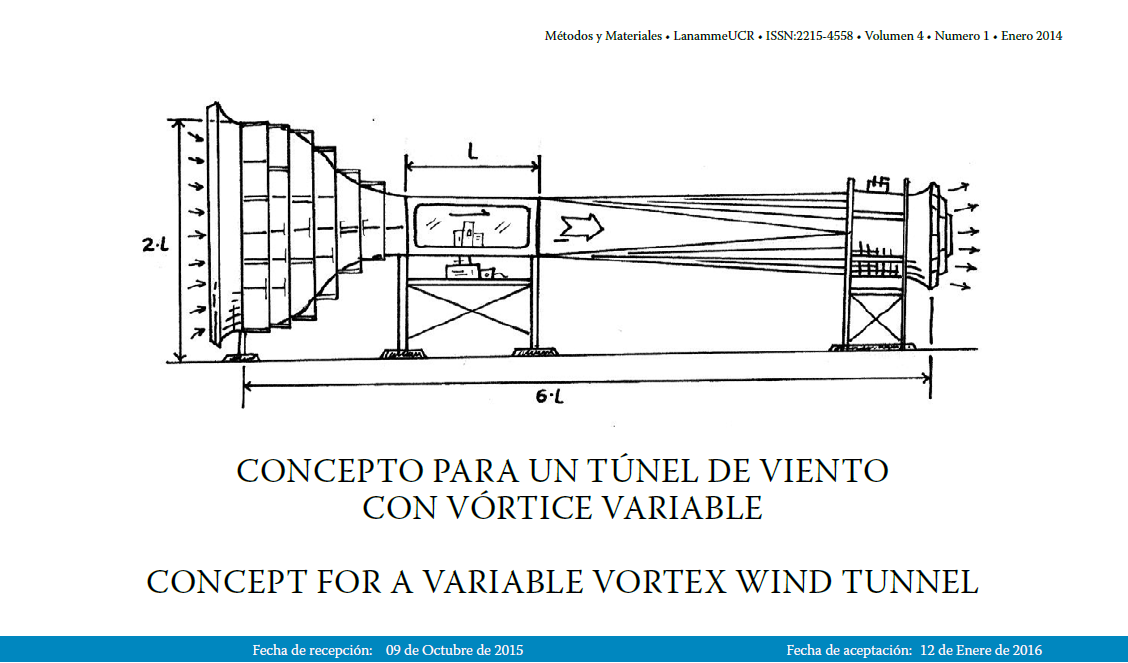
    This paper describes the basic design of a low-cost boundary layer wind tunnel specially conceived to be much shorter than conventional environmental wind tunnels while allowing for real-time adjustment of vortex size and speed without needing to alter mean flow speed or affecting fan performance. Potential applications include medium scale modeling of atmospheric wind as it interacts with large urban areas, soil erosion, sediment transportation, and large-area pollution dispersion. Also, calibration of some numerical models of two dimensional low-speed fluid flow may be accomplished with adequate instrumentation.