
Skip to main navigation menu Skip to main content Skip to site footer

Volume 7Enero - Diciembre 2017

Published September 4, 2025

Issue description

Enero - Diciembre 2017

Articles

  1. Interpretation from the Kinetic Analysis of the Accelerated Test Results (IRAM 1674) for the Alkali-Silica Reaction

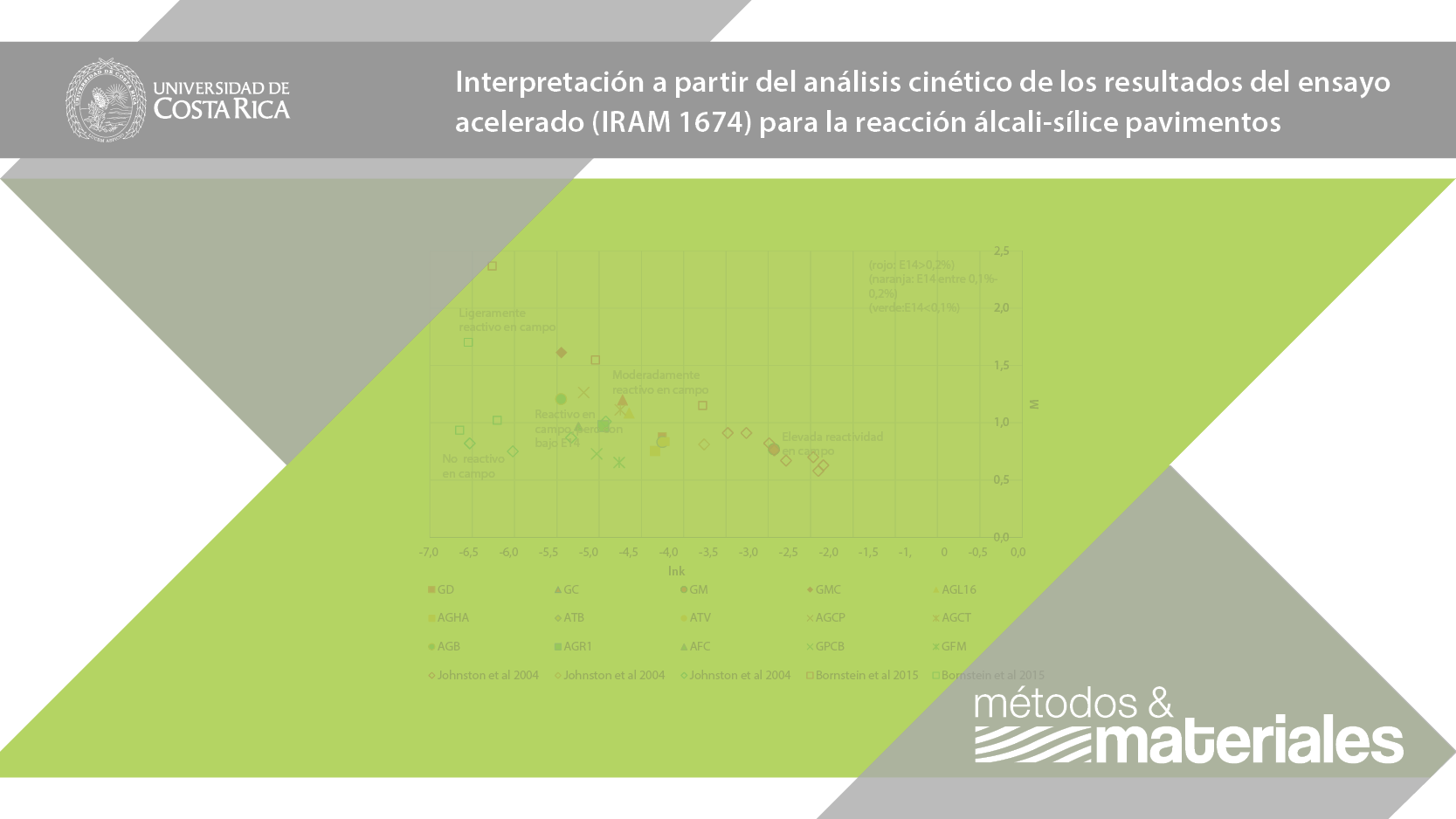
    The expansion of the accelerated test in mortar bars test immersed for 14 days in an aggressive solution (IRAM 1674) as well as the kinetic analysis according to RILEM AAR-2 recommendations for the study of the potencial deleterious of the aggregate in the alkali-silica reaction are presented in this work. The main objective is to contribute to the interpretation of the test results based on the analysis of the growth in expansion with the time of immersion (kinetic analysis) and in this way, get more reliability. The kinetic analysis consists in adjusting by least squares fit of the experimental data of expansion to a known mathematical model (model KAMJ), where the parameters lnk and M are obtained from.

    The kinetic parameters lnk and M are associated with the behavior of the reaction. Although a limit value for lnk of -6 is proposed in the literature (lower values are non-reactive aggregates and higher values are deleterious aggregate), from the analysis of the experimental data it was observed that low values of this parameter could be associated with not asymptotic growth of expansion and, therefore, the aggregates presents a deleterious behavior. The lnk/M coefficient is considered a good indicator to evaluate the behavior of the aggregate. However, in order to define a limit value for lnk/M coefficient, it is necessary to establish a correlation with the tests on long-term concrete prism (1 year or more) or the field experience of the aggregate behavior.


  2. Comparison of Asphalt Content Methods of Hot Asphalt Mix

    The composition of the hot asphalt mixture used for pavements is defined according to a design that try to meet the performance according the project in which it is to be used. Since asphalt is the binding material that provides cohesion and adhesion to the mixture, it is important to be able to quantify if the mixture produced contains the amount of asphalt established in the mix design, for that different tests have been developed to determine the content of asphalt. Although the purpose of the test methods is the same, there are doubts about the accuracy of some of them, and especially about the correlation between test procedures. This study aims to provide real results of an asphalt mix produced in a production plant, which is analyzed using the different methods and equipment to compare them with the production data and thus determine the precision and accuracy of each procedure.

    The results show that the methods of incineration by resistance furnace, incineration in the infrared furnace and the solvent extraction method using centrifuge do not present significant statistical differences, which is not the case with the solvent extraction method using a reflux system. The latter, despite being the one with the lowest variability, is also the most distant from the design asphalt content. However, the four methods studied are within the tolerance allowed by national regulations with respect to the asphalt content established in the blend design.

    In addition, as some laboratories use the gasoline extraction method as solvent instead of ACS grade trichlorethylene, the extraction test is performed using both solvents to determine whether the result with the alternative solvent is reliable. The results obtained discard it as solvent, as it does not produce statistically comparable results with the method when using trichlorethylene.

  3. Quantification of V, Ni, Zn and Fe in Asphalt by Atomic Absorption Spectroscopy

    Asphalt has complex chemical and physical compositions that normally vary with the source of crude oil. Its composition is based on approximately 84% C, 10% H2, 1% O2 and 5% trace elements such as S, Ni, V and Fe. This is the development of a new method to quantify V, Ni, Zn and Fe on asphalt AC-30 by atomic absorption spectroscopy. These metals were detected qualitatively with a higher intensity in an X-ray analysis by fluorescence in an electron scanning microscope. Some metals found in asphalt may have a catalytic effect on the oxidation of asphalt.The research proposes a treatment process of up to 2 g of asphalt, which is based on dilution with mineral spirits in volumetric flasks with the aid of an ultrasonic bath to lighten the dilution. The parameters of optimization of the method are dictated by looking for the adequate instrumental data in the atomic absorption equipment to obtain the highest possible absorbance in the alignment of both the burner and the hollow cathode and deuterium lamps; In addition to the optimization of the flame and the flow of the nebulizer. The calibration curves of each metal were performed with a hydrocarbon-based standard to measure metal concentrations in asphalt in mg / kg with a linear correlation coefficient of at least 0,995. The asphalt recovery study is performed with the addition of a quantity of the metals directly to the asphalt matrix aliquots. The concentrations obtained for Ni were 70, V 330, Zn 24 and for Fe 10 ppm, which presented a relative standard deviation of less than 1%, indicating that measurements of the same sample are accurate and have little dispersion between them. The average recoveries were 99,17% for Ni, 100,30% V, 92,26% Zn and 97,72% Fe. These results indicate that the method is reliable for the quantification of metals by the atomic absorption technique; values greater than 100% are given by readings of absorbances higher than expected or by generation of false positives in the technique. 

  4. Proposed Modification of the Dynamic Module Test Run Sequence

    In recent years, different test methods and procedures have been developed to evaluate the rheological properties of asphalt materials, some of which have been incorporated in design methodologies and standards in Mexico. However, the correct determination of mechanical properties of asphalt mix involves complex evaluations and the need for other areas of knowledge as metrology, instrumentation and data processing, combined with a clear understanding of the mechanical behavior of a viscoelastic material. This is the case for the dynamic modulus test, which aims to evaluate the linear viscoelastic properties of the asphalt mixture by determining two mechanical parameters, the dynamic or complex module (|E*|) and the phase angle (δ).

    The present article illustrates the evaluation of the viscoelastic properties of an asphalt mixture and the analysis of the data obtained in tests. Indicating some of the general errors in the conduction of the test and to justify the test sequence proposed by the IMT regarding the AASHTO T 342 Standard, which does not alter the identification of the linear viscoelastic properties of the asphalt mixture. 

  5. The use of a Method for Structural Design of Ring-Girders used in Penstocks

    The methodology that calculates the internal stresses on a penstock shell restrained by a rigid ring girder was developed since the 1930’s, however, its automatization has not been implemented by commercial use software due to its complexity. This projectintends to automate one methodology to calculate the internal stresses on a steel penstock shellrestrained bya ring-girder. A penstock under normal operation condition, this is apipe full of water under pressure, was analyzed. A calculating tool was produced using EXCEL 2016 and Mathcad 10, for calculating the internal stresseson the penstock’s ring girder cross sections. The tool doesn’t consider the earthquake loading conditions.