Skip to main navigation menu Skip to main content Skip to site footer

Volume 11Enero - Diciembre 2021

Published September 8, 2025

Issue description

Enero - Diciembre 2021

Articles

  1. Experimental assessment of the behavior of prefabricated concrete elements (horizontal tiles and columns), under the application of perpendicular loads to the wall plane

    In this research it was studied the prefabricated system of columns and horizontal tiles with uniformly distributed loads perpendicular to the plane of the wall. For this, a wall on natural scale was built, It was made by two groups of tiles, top plate beam and concrete foundation. The load was applied with air bags to generate a uniform pressure on the wall.

    The most important result is the experimental verification that the columns are the critical design element in prefabricate system of columns and horizontal tiles. It was also possible to demonstrate that the resistant requirements stablished in INTE C131:2019 are adequate for support wind and earthquake pressure safely.

  2. The Use of mineral additive as a modifier of the mechanical properties in concrete: a review

    This article collects and identifies the addition of certain mineral additives most frequently used in the construction industry as modifiers of concrete during its fresh and hardened state, most of which are used as a partial replacement for cement. Currently researchers seek to optimize the properties of the design of mixtures depending on the use for which they are conceived, as well as that it is economically feasible and respectful with the environment. 50 articles indexed between 2010 and 2021 distributed in the following databases were reviewed: 37 articles from Scopus, 10 articles from ScienceDirect, 2 articles from Springer and 1 article from SciELO. The additives under study are granulated blast furnace slag (EAHG), fly ash (CV), silica fume (HS), rice husk ash (CCA). Most of them present a considerable improvement in their mechanical characteristics of traction, resistance to compression and modulus of elasticity. The addition of CV improves the mix of the design during its fresh state, the CCA during its hardened state and the best resistances for the HS; However, the EAHG turns out to meet almost all expectations in a higher percentage and likewise, together with the CCA, they are potentially competitive

  3. Design of a dashboard for monitoring the performance of a tower crane in a construction project

    The tower crane is an equipment with a high operating cost and critical for the advancement of vertical constructions. Therefore, the need arises to have instruments that allow controlling the performance of the tower crane in vertical construction projects. In this investigation, a dashboard was created, which makes it possible to measure and control the performance of the tower crane during the execution of the construction project. The designed tool was implemented in the construction of a building with a structural system composed of walls, columns and posttensioned slabs. Only one tower crane was studied. On some occasions, logical and reasonable causes were provided to explain a certain behavior of the analyzed tower crane. However, these causes may be neither the only ones nor the definitive ones. Work sampling was used to obtain representativeness in the samples. It is estimated that the proposed tool will bring the following improvements: focus of the tower crane on the most critical tasks; measurement and improvement of the productivity of various tasks essential for advancement; determination and reduction of the percentage of downtime; better monitoring of incidents and reduction of accidents, which reduces the time in which the project is stopped due to accidents; and, finally, greater monitoring of tower crane maintenance, which reduces the time in which the equipment is stopped due to failures. The cost of implementing the tool presented is viable for most companies in charge of vertical constructions. The cost-benefit ratio of the proposed instrument was estimated at factor of 9.8, which suggests that the benefits of the tool are considerably greater than its costs.

  4. Coloring of recycled rubber and plastic tiles and their opto-thermal response

    Energy efficiency consists of achieving lower energy consumption compared to the same benefit

    The different amount of solar radiation that is reflected or absorbed is due to the surface color.

    The tiles developed in this research are black, as they have rubber particles in their composition, which contain carbon black. Dark colors have a higher solar absorptivity, therefore, the alternative of coloring the tiles with light colors was analyzed, to reduce the absorption of solar radiation. The objective is to evaluate different technical possibilities for laying tiles from the incorporation of pigments, and to determine the energy efficiency. For manufacturing, colored oxides, masterbatch, rubber and polyethylene were incorporated. Experiments were carried out varying their dosages and for the determination of the thermo-physical behavior of the tiles, optical properties (albedo and emissivity) and surface temperature of 2 sample units were tested -one tile colored in green and one in black-. The group with the best results was number 3, where black rubber, green polyethylene and masterbatch were mixed. When comparing the thermo-physical performance of recycled green tiles in relation to black tiles, a more efficient behavior was observed in green tiles. Increases in the albedo level of 11% and decreases in surface temperature greater than 8 ° C were recorded.


    Energy efficiency consists of achieving lower energy consumption compared to the same benefit

    The different amount of solar radiation that is reflected or absorbed is due to the surface color.

    The tiles developed in this research are black, as they have rubber particles in their composition, which contain carbon black. Dark colors have a higher solar absorptivity, therefore, the alternative of coloring the tiles with light colors was analyzed, to reduce the absorption of solar radiation. The objective is to evaluate different technical possibilities for laying tiles from the incorporation of pigments, and to determine the energy efficiency. For manufacturing, colored oxides, masterbatch, rubber and polyethylene were incorporated. Experiments were carried out varying their dosages and for the determination of the thermo-physical behavior of the tiles, optical properties (albedo and emissivity) and surface temperature of 2 sample units were tested -one tile colored in green and one in black-. The group with the best results was number 3, where black rubber, green polyethylene and masterbatch were mixed. When comparing the thermo-physical performance of recycled green tiles in relation to black tiles, a more efficient behavior was observed in green tiles. Increases in the albedo level of 11% and decreases in surface temperature greater than 8 ° C were recorded.

    Energy efficiency consists of achieving lower energy consumption compared to the same benefit

    The different amount of solar radiation that is reflected or absorbed is due to the surface color.

    The tiles developed in this research are black, as they have rubber particles in their composition, which contain carbon black. Dark colors have a higher solar absorptivity, therefore, the alternative of coloring the tiles with light colors was analyzed, to reduce the absorption of solar radiation. The objective is to evaluate different technical possibilities for laying tiles from the incorporation of pigments, and to determine the energy efficiency. For manufacturing, colored oxides, masterbatch, rubber and polyethylene were incorporated. Experiments were carried out varying their dosages and for the determination of the thermo-physical behavior of the tiles, optical properties (albedo and emissivity) and surface temperature of 2 sample units were tested -one tile colored in green and one in black-. The group with the best results was number 3, where black rubber, green polyethylene and masterbatch were mixed. When comparing the thermo-physical performance of recycled green tiles in relation to black tiles, a more efficient behavior was observed in green tiles. Increases in the albedo level of 11% and decreases in surface temperature greater than 8 ° C were recorded.
  5. Sparse sensing Bridge Weigh-In-Motion for single-span bridges

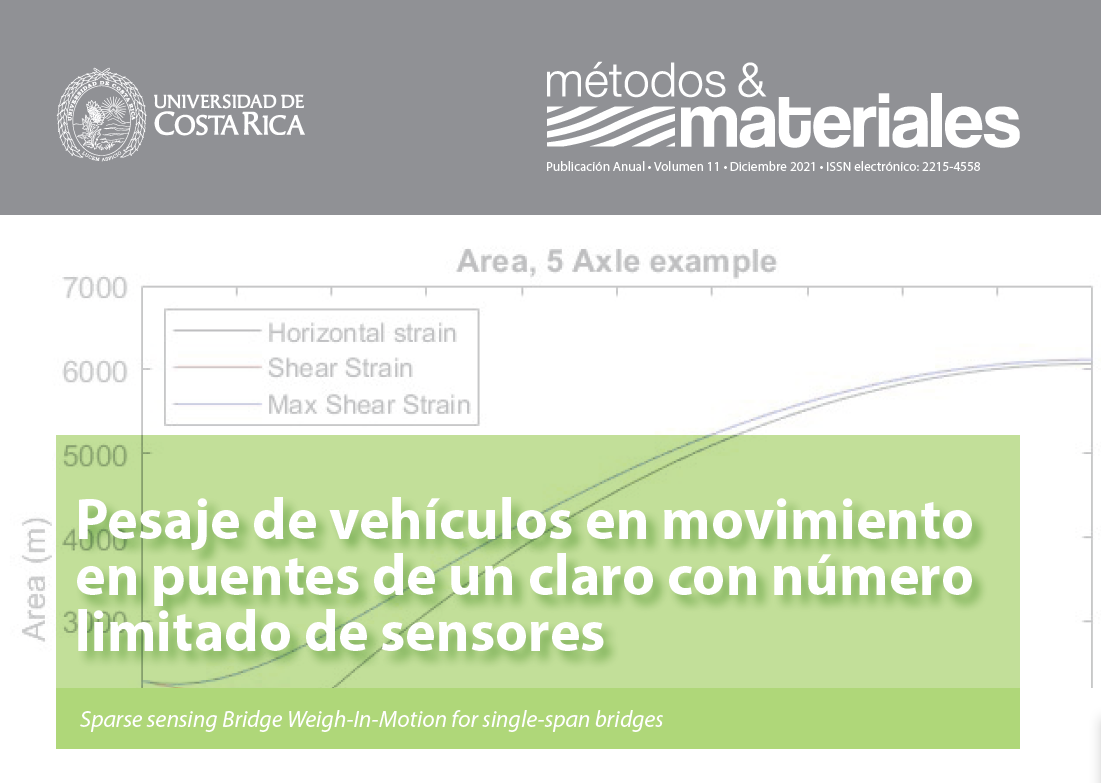
    In emerging economies, the implementation of Transportation Infrastructure Management is a prevailing need. In order to use limited available resources in the most efficient way, technology emerges as a strategic ally. For the purpose of pavement and bridge preservation, different methodologies have been developed for the detection of overweight vehicles. This article presents the implementation and validation of Bridge Weigh-In-Motion (BWIM) located in Costa Rica through the instrumentation of an in-service highway bridge with minimal instrumentation requirements. The approach used was based on the concept of influence area from strain response time histories. Given the location of the sensors near the bridge abutment to reduce installation requirements, two types of strain responses were analyzed based on horizontal strain and shear strain in order to define quantity and location of sensors for possible implementations. Two calibration trucks were used as reference for calibration and the weight from over 90 trucks were estimated and compared to static measurements from a nearby permanent static weigh station.