

Archives
-
january-june 2026
No. 51 (2026)N. 51, january-june 2026
-

Special issues
No. Especial (2025)The Revista Estudios is pleased in presenting the número especial 2025. This publication completes a series of seven articles which connects the commemoration of two key moments in the existence of the University of Costa Rica. First, the 50 dossier Anniversary of the Participatory Seminars that celebrates the existence of this methodological option as part of the 1974-1975 Escuela de Estudios’s proposal which is inclined to the humanistic formation of freshman students. Second, the 85 Anniversary of the University of Costa Rica as a rewarded superior education institution. The articles make us consider topics as the critical thinking, the participatory and co-manage methodology in the construction of knowledge, the view of the ecological crisis with a cosmological point of view and the multidisciplinary as a space for superior humanistic education dialog in the digital era.
In this same publication, we present five articles where the authors drive us in a time travel. We begin by two literary texts. The first one analyses important battles for the reconquest of the Iberic Peninsula in the XII and XIII centuries: Alarcos, who presents the defeat of Cristian tropes, the cease to the process of reconquest, and the battle in Navas de Tolosa, which was an important victory in the process of reconquest. The second article takes us to Costa Rica in the XX century with an critical analysis of the discourse in the tell “La Bruja” (The witch) by Fabian Dobles (1955). In this analysis, aspects as power and misogyny will be consider to understand the sociocultural representations that are repositories of discourses that justify female violence, whom in this social context challenges the predestinated order.
As well in the XX century, two articles drive us to the religious mentality seen from different points of views. One of the articles will analyze the Semana Santa (Easter) in Costa Rica in the second half of the XX century; a time where the day to day life was taken apart to give room to a series of religious practices focused not only in faith, but also in the social factor of the holyday, which appears due to the interaction among the people involved in the organization of the activities and the non-organizers. The other article address the history and the truth as fundamental categories of the philosophy of Ignacio Ellacuría’s, who is a leading figure in the theology of the liberation in Central America in historical period that is characterized by the presence of armed conflicts. According to the author, the article is about the ideological construction that the US have done of the regional situation.
Finally, we passed from the art world and the ideas present in literature, religious practices and philosophical categories to considerations a lot earthlier and concrete in an article that talks about the Center of Geophysical Investigation (CIGEFI by its acronym in Spanish) among 1979-2022. The authors prove how the relevance of atmospherically Physics was reduced in the first two decades of its existence giving space in the 1990 to a vacuolation of the Social Sciences by means of a multi, trans, and interdisciplinary in the analysis of the geophysical phenomena.
With all of this said, we invite you to read our 2025 special edition.
M.Sc. Verónica Jerez Brenes
Director
-
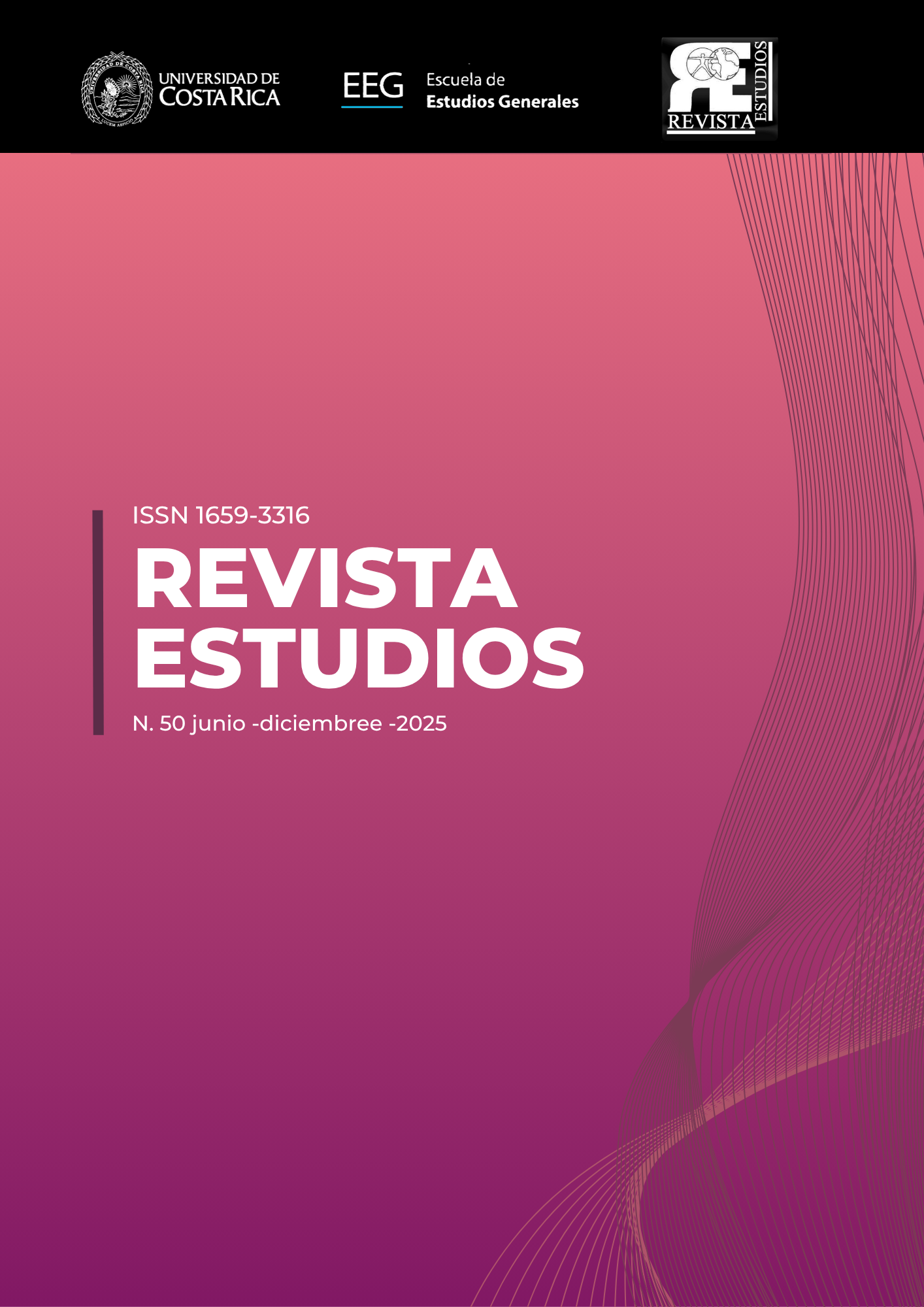
june-december 2025
No. 50 (2025)Revista Estudios is pleased to announce the publication of its 50th issue, which is organized around three thematic axes. The first axis is composed of a Dossier that links religious beliefs with their practices with spirituality and emotionality. It does so from different perspectives, including traditional religions, New Age therapies, and those emerging from interactions with social media. The union between spirituality and health, be it physical, mental, or emotional, leads us to a plurality of beliefs that are not static; on the contrary, they take part in a dynamic and deeply human process. In this case, religious practices and the emotional and spiritual are examined within the Mexican context and include a diverse perspective.
The second axis of this issue concerns politics and governance, approached through two specific topics. The first one offers an analysis on the proposals of cultural heritage gathered from electoral programs of Spain’s main political parties, such as speeches, as they reveal their social and ideological construct. The second one focuses on migratory governance and its impact on the reconfiguration of the Mexican migration policy, as the international governance faces several obstacles that hinder its implementation in many contexts. These have to do with the nature of human migration and the impact of other current political factors.
The third and last axis present on the 50th issue is related to pedagogy and innovation in teaching. These articles join the study of classical texts and the role of the teacher, creating a break based on the proposition that the model of the “great works” is the origin of general education as a pedagogical model. Lastly, this issue presents a proposal for the incorporation of diversified strategies, as they foster the creation of inclusive educational environments that show several ways to perceive the world and generate knowledge. This creation should be measured by the participation of students with different learning styles, conditions, and neurodivergence to be in accordance with a participatory and inclusive approach.
On behalf of the editorial team of Revista Estudios, which I now join as director with this issue, I invite you to read and download the articles that are part of this issue. These propose an innovative point of view that, for many, forms an important part of their lived experience.
M.Sc. Verónica Jerez Brenes
Director
¿Busca los artículos anteriores? visite archivo.revistas.ucr.ac.cr
Looking of back issues? go to: archivo.revistas.ucr.ac.cr


