Survival or traditional statistics? Shelf life estimation of purple corn (Zea mays L.) premix
DOI:
https://doi.org/10.15517/am.2024.60261Keywords:
food storage, prediction techniques, statistical models, sensory evaluation, corn flourAbstract
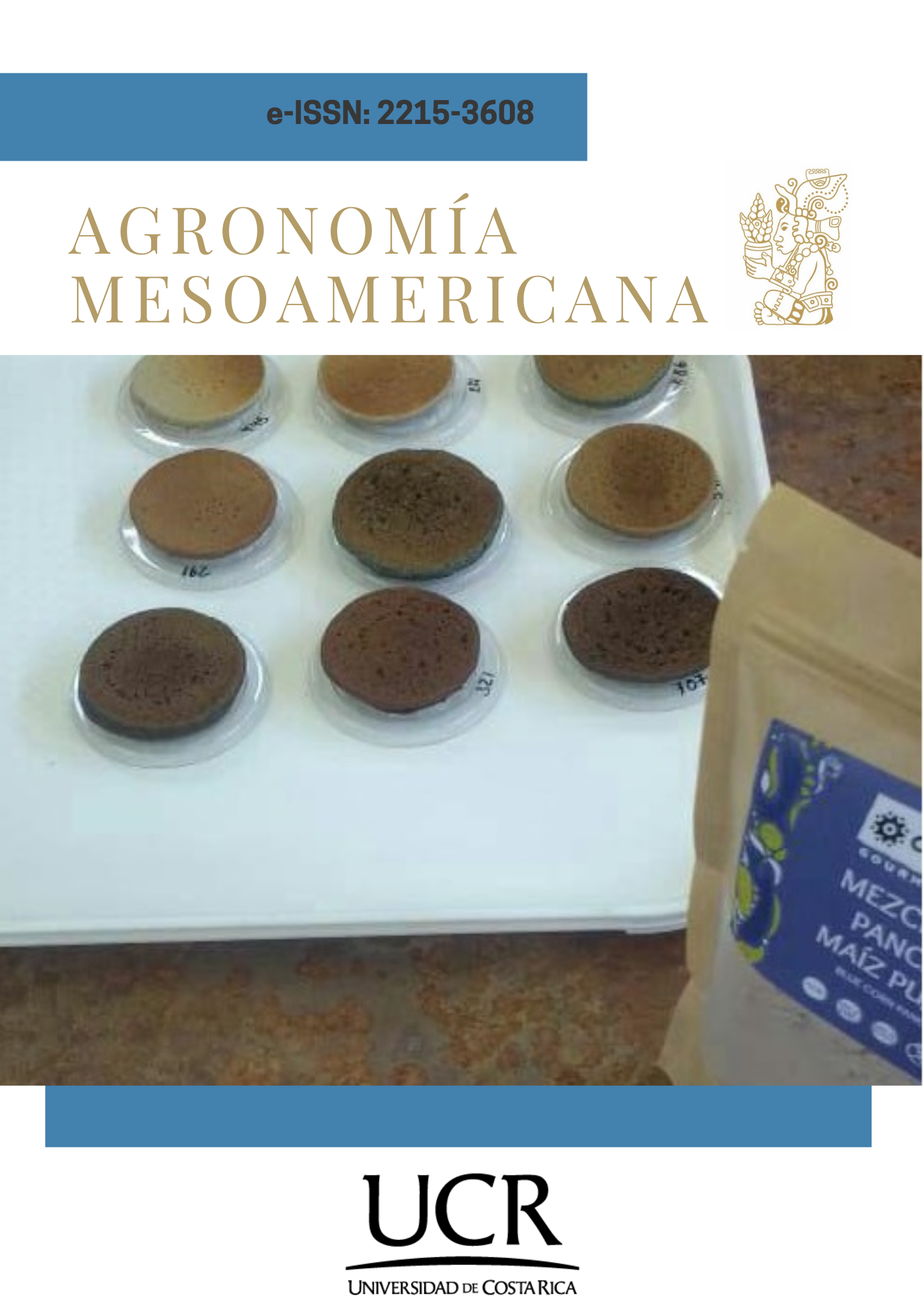
Introduction. Since the product development process is incomplete without determining its shelf life, the creation of a novel product, such as pancake premix based on purple corn flour, raised the need to determine it. Objective. To estimate the shelf life of a pancake premix made from pujagua corn flour (Zea mays L.), using linear regression analysis and survival statistics to compare both methodologies. Materials and methods. The study was conducted at the Centro Nacional de Ciencia y Tecnología de Alimentos (CITA) of the Universidad de Costa Rica, from 2018 to 2023. The pancake premix storage study was carried out with three repetitions, in a chamber at 25 °C, with control samples stored at -18 °C for 7.5 months, and nine sampling times at intervals of 26 days. Sensory variables analyzed from the pancakes were chewiness and off-flavor, while off-odor was selected for the premix. A consumers acceptance test (n=100) was conducted. Based on these results and data from a panel of judges (n=11), two shelf life values were calculated, one using the cut-off point method and the other using survival statistics. Results. The sensory variable limiting the shelf life of the premix was chewiness. The cut-off point method estimated a shelf life of 124 days, while the survival statistics method estimated 265 days at 25 °C. The cut-off point method was more conservative and sensitive to the selected critical variables, whereas the survival statistics method proved more practical. Conclusions. This study estimated the shelf life of the premix using both methodologies, demonstrating the benefits of each approach.
Downloads
References
Arellano Vázquez, J. L., Tut Couoh, C., Ramírez, A. M., Salinas Moreno, Y., & Taboada Gaytán, O. R. (2003). Maíz azul de los Valles Altos de México. I. Rendimiento de grano y caracteres agronómicos. Revista Fitotecnia Mexicana, 26(2), 101–107. https://doi.org/10.35196/rfm.2003.2.101 DOI: https://doi.org/10.35196/rfm.2003.2.101
Awulachew, M. T. (2021). Understanding to the shelf-life and product stability of foods. Journal of Food Technology and Preservation, 5(8), 1–5. https://www.alliedacademies.org/articles/understanding-to-the-shelflife-and-product-stability-of-foods.pdf
Bustamante, B. (2022). Aplicación de dos metodologías (de punto de corte y de riesgos acumulados de Weibull) para la determinación de la vida útil del pan de molde blanco. Revista de Investigación Agropecuaria Science and Biotechnology, 2(2), 25–38. https://doi.org/10.25127/riagrop.20222.826 DOI: https://doi.org/10.25127/riagrop.20222.826
Cardelli, C., & Labuza, T. P. (2001). Application of Weibull hazard analysis to the determination of the shelf life of roasted and ground coffee. LWT - Food Science and Technology, 34(5), 273–278. https://doi.org/10.1006/FSTL.2000.0732 DOI: https://doi.org/10.1006/fstl.2000.0732
Chacón Lizano, M. (2017, septiembre 27). Evolución del cultivo de maíz en Costa Rica. Oficina Nacional de Semillas. Recuperado el 19 de abril, 2024, de http://ofinase.go.cr/certificacion-de-semillas/certificacion-de-semillas-de-maiz/evolucion-cultivo-maiz/
Corradini, M. G. (2018). Shelf life of food products: from open labeling to real-time measurements. Annual Review of Food Science and Technology, 9, 251–269. https://doi.org/10.1146/annurev-food-030117-012433 DOI: https://doi.org/10.1146/annurev-food-030117-012433
Cruz, A. G., Walter, E. H. M., Silva Cadena, R., Faria, J. A. F., Bolini, H. M. A., Pinheiro, H. P., & Sant´Ana, A. S. (2010). Survival analysis methodology to predict the shelf-life of probiotic flavored yogurt. Food Research International, 43(5), 1444–1448. http://dx.doi.org/10.1016/j.foodres.2010.04.028 DOI: https://doi.org/10.1016/j.foodres.2010.04.028
Cueva Ríos, M. A., Fernández Rosillo, F., Quiñones Huatangari, L., & Cabrejos Barrios, E. M. (2023). Estimation of coffee shelf life under accelerated storage conditions using mathematical models - Systematic review. Czech Journal of Food Sciences, 41(2), 92–102. https://doi.org/10.17221/163/2022-CJFS DOI: https://doi.org/10.17221/163/2022-CJFS
Curia, A., Aguerrido, M., Langohr, K., & Hough, G. (2006). Survival analysis applied to sensory shelf life of yogurts–I: Argentine formulations. Journal of Food Science, 70(7), s442–s445. https://doi.org/10.1111/J.1365-2621.2005.TB11489.X DOI: https://doi.org/10.1111/j.1365-2621.2005.tb11489.x
de Bouillé, A. G., & Beeren, C. J. M. (2016). Sensory evaluation methods for food and beverage shelf life assessment. In P. Subramaniam (Ed.), The stability and shelf life of food (2nd ed., pp. 199–228). Woodhead Publishing. https://doi.org/10.1016/B978-0-08-100435-7.00007-1 DOI: https://doi.org/10.1016/B978-0-08-100435-7.00007-1
Elías, C., Salas, W., de Mendiburu, F., & de la Cruz, W. (2011). Estimación del tiempo de vida útil de pan de molde con incorporación de harina de quinua (Chenopodium quinoa Willd) y suero, usando la distribución de Weibull. Anales Científicos, 72(1), 27–33. https://doi.org/10.21704/ac.v72i1.874 DOI: https://doi.org/10.21704/ac.v72i1.874
Garitta, L., & Hough, G. (2012). Modeling shelf life using survival analysis methodologies. In M. C. Nicoli (Ed.), Shelf-life assessment of food (pp. 169–197). CRC Press. DOI: https://doi.org/10.1201/b11871-8
Garitta, L., Langohr, K., Gómez, G., Hough, G., & Beeren, C. (2015). Sensory cut-off point obtained from survival analysis statistics. Food Quality and Preference, 43, 135–140. https://doi.org/10.1016/J.FOODQUAL.2015.02.012 DOI: https://doi.org/10.1016/j.foodqual.2015.02.012
Giménez, A., & Ares, G. (2019). 11- Sensory shelf life estimation. In C. M. Galanakis (Ed.), Food quality and shelf life (pp. 333–357). Academic Press. https://doi.org/10.1016/B978-0-12-817190-5.00011-2 DOI: https://doi.org/10.1016/B978-0-12-817190-5.00011-2
Giménez, A., Ares, F., & Ares, G. (2012). Sensory shelf-life estimation: A review of current methodological approaches. Food Research International, 49(1), 311–325. https://doi.org/10.1016/J.FOODRES.2012.07.008 DOI: https://doi.org/10.1016/j.foodres.2012.07.008
Giménez, A., Ares, G., & Gámbaro, A. (2008). Survival analysis to estimate sensory shelf life using acceptability scores. Journal of Sensory Studies, 23(5), 571–582. http://dx.doi.org/10.1111/j.1745-459X.2008.00173.x DOI: https://doi.org/10.1111/j.1745-459X.2008.00173.x
Giménez, A., Varela, P., Salvador, A., Ares, G., Fiszman, S., & Garitta, L. (2007). Shelf life estimation of brown pan bread: A consumer approach. Food Quality and Preference, 18(2), 196–204. https://doi.org/10.1016/J.FOODQUAL.2005.09.017 DOI: https://doi.org/10.1016/j.foodqual.2005.09.017
Hasjim, J., Lee, S.-O., Hendrich, S., Setiawan, S., Ai, Y., & Jane, J.-l. (2010). Characterization of a novel resistant-starch and its effects on postprandial plasma-glucose and insulin responses. Cereal Chemistry, 87(4), 257–262. http://dx.doi.org/10.1094/CCHEM-87-4-0257 DOI: https://doi.org/10.1094/CCHEM-87-4-0257
Hough, G. (2010). Sensory shelf life estimation of food products (1st ed.). CRC Press. https://doi.org/10.1201/9781420092943 DOI: https://doi.org/10.1201/9781420092943
Hough, G., & Fiszman, S. (2005). Estimación de la vida útil sensorial de los alimentos (1ª ed.). Programa Iberoamericano de Ciencia y Tecnología para el Desarrollo.
Hough, G., & Garitta, L. (2012). Methodology for sensory shelf-life estimation: A review. Journal of Sensory Studies, 27(3), 137–147. https://doi.org/10.1111/J.1745-459X.2012.00383.X DOI: https://doi.org/10.1111/j.1745-459X.2012.00383.x
Hough, G., Garitta, L., & Gómez, G. (2006). Sensory shelf-life predictions by survival analysis accelerated storage models. Food Quality and Preference, 17(6), 468–473. http://dx.doi.org/10.1016/j.foodqual.2005.05.009 DOI: https://doi.org/10.1016/j.foodqual.2005.05.009
Hough, G., Langohr, K., Gómez, G., & Curia, A. (2003). Survival analysis applied to sensory shelf life of foods. Journal of Food Science, 68(1), 359–362. http://dx.doi.org/10.1111/j.1365-2621.2003.tb14165.x DOI: https://doi.org/10.1111/j.1365-2621.2003.tb14165.x
Instituto Nacional de Estadística y Censos. (2018, noviembre 19). Encuesta nacional agropecuaria. 2017. Resultados generales de la actividad agrícola y forestal. Recuperado el 19 de abril, 2024, de http://www.inec.go.cr/multimedia/encuesta-nacional-agropecuaria-2017-resultados-generales-de-la-actividad-agricola-y
Instituto Nacional de Estadística y Censos. (2019). Comercio exterior 2018. Estadísticas de comercio exterior. Recuperado el 19 de abril, 2024, de https://inec.cr/multimedia/comercio-exterior-2018-estadisticas-comercio-exterior
Ishaq, A. I., & Abiodun, A. A. (2020). The Maxwell–Weibull distribution in modeling lifetime datasets. Annals of Data Science, 7, 639–662. https://doi.org/10.1007/s40745-020-00288-8 DOI: https://doi.org/10.1007/s40745-020-00288-8
Labuschagne, M., Phalafala, L., Osthoff, G., & van Biljon, A. (2014). The influence of storage conditions on starch and amylose content of South African quality protein maize and normal maize hybrids. Journal of Stored Products Research, 56, 16–20. http://dx.doi.org/10.1016/j.jspr.2013.11.004 DOI: https://doi.org/10.1016/j.jspr.2013.11.004
Lazzari, L. (2017). 8- Statistical analysis of corrosion data. In L. Lazzari (Ed.), Engineering tools for corrosion (Vol. 68, pp. 131–148). Woodhead Publishing. https://doi.org/10.1016/B978-0-08-102424-9.00008-2 DOI: https://doi.org/10.1016/B978-0-08-102424-9.00008-2
López-Duarte, A. L., & Vidal-Quintanar, R. L. (2009). Oxidation of linoleic acid as a marker for shelf life of corn flour. Food Chemistry, 114(2), 478–483. http://dx.doi.org/10.1016/j.foodchem.2008.09.105 DOI: https://doi.org/10.1016/j.foodchem.2008.09.105
Man, C. M. D. (2015). Shelf life (2nd ed.). John Wiley & Son. DOI: https://doi.org/10.1002/9781118346235
Mayorga, A. L., & Pérez, A. M. (2018). Maíz morado. En S. G. Sáyago Ayerdi, & E. Álvarez Parrilla (Eds.), Alimentos vegetales autóctonos iberoamericanos subutilizados (pp. 161–176). Fabro Editores.
Mestres, C., Nago, M., Akissoë, N., & Matencio, F. (1997). End use quality of some African corn kernels. 2. Cooking behavior of whole dry-milled maize flours; incidence of storage. Journal of Agricultural and Food Chemistry, 45(3), 565–571. https://doi.org/10.1021/jf9605660 DOI: https://doi.org/10.1021/jf9605660
Onyeoziri, I. O., Torres-Aguilar, P., Hamaker, B. R., Taylor, J. R. N., & de Kock, H. L. (2021). Descriptive sensory analysis of instant porridge from stored wholegrain and decorticated pearl millet flour cooked, stabilized and improved by using a low-cost extruder. Journal of Food Science, 86(9), 3824–3838. http://dx.doi.org/10.1111/1750-3841.15862 DOI: https://doi.org/10.1111/1750-3841.15862
Quispe, P., & Macavilca, E. A. (2019). Optimización sensorial de un néctar mixto de papaya y maracuyá aplicando el análisis de supervivencia a la respuesta de los consumidores. Peruvian Agricultural Research, 1(1), 1–6. https://doi.org/10.51431/par.v1i1.475 DOI: https://doi.org/10.51431/par.v1i1.475
Salman, H., & Copeland, L. (2007). Effect of storage on fat acidity and pasting characteristics of wheat flour. Cereal Chemistry, 84(6), 600–606. http://dx.doi.org/10.1094/CCHEM-84-6-0600 DOI: https://doi.org/10.1094/CCHEM-84-6-0600
Salvador, A., Varela, P., Fiszman, S. M., & Gómez, G. (2006). Estimating the shelf life of brown pan bread, suitability of survival analysis methodology. Journal of Food Science, 71(4), S321–S325. http://dx.doi.org/10.1111/j.1750-3841.2006.00002.x DOI: https://doi.org/10.1111/j.1750-3841.2006.00002.x
Sánchez-González, J. A., & Pérez Cueva, J. A. (2016). Vida útil sensorial del queso mantecoso por pruebas aceleradas. Scientia Agropecuaria, 7(3), 215–222. https://doi.org/10.17268/sci.agropecu.2016.03.08 DOI: https://doi.org/10.17268/sci.agropecu.2016.03.08
Shobha, D., Dileep kumar, H. V., Sreeramasetty, T. A., Puttaramanaik, Pandurange Gowda, K. T., & Shivakumar, G. B. (2014). Storage influence on the functional, sensory and keeping quality of quality protein maize flour. Journal of Food Science and Technology, 51, 3154–3162. http://dx.doi.org/10.1007/s13197-012-0788-7 DOI: https://doi.org/10.1007/s13197-012-0788-7
Villanueva, N. D. M., Petenate, A. J., & Da Silva, M. A. A. P. (2005). Performance of the hybrid hedonic scale as compared to the traditional hedonic, self-adjusting and ranking scales. Food Quality and Preference, 16(8), 691–703. https://doi.org/10.1016/j.foodqual.2005.03.013 DOI: https://doi.org/10.1016/j.foodqual.2005.03.013
Additional Files
Published
Issue
Section
License
Copyright (c) 2024 Ileana Morales-Herrera, Elena López-Vargas, Pilar Fallas-Rodríguez, Ana M. Pérez (Autor/a)

This work is licensed under a Creative Commons Attribution-NonCommercial-NoDerivatives 4.0 International License.
How to Cite